Introduction
When industries enter a developing region, they do more than create factories and production facilities. They can also create jobs, attract workers, bring supporting businesses and gradually increase the need for housing and everyday services.
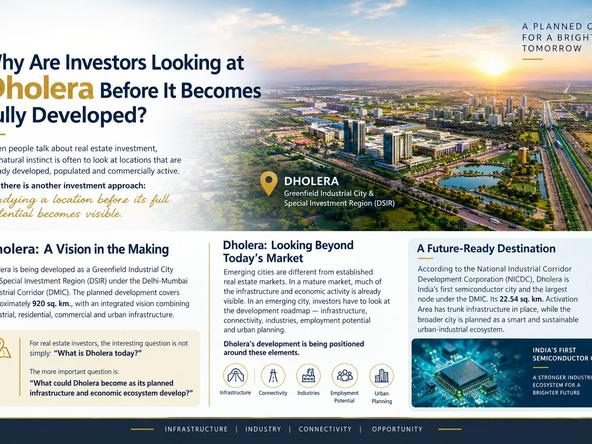
This relationship is particularly important for Dholera Special Investment Region (DSIR), Gujarat, which is being developed as a greenfield industrial city under the Delhi–Mumbai Industrial Corridor (DMIC).
Dholera spans approximately 920 sq. km, with a 22.54 sq. km Activation Area developed with trunk infrastructure. NICDC identifies semiconductors, aerospace and defence, solar component manufacturing, green hydrogen, pharmaceuticals and biotechnology, and heavy engineering among its focus sectors.
As industrial activity develops, one important question for the real estate market is:
How can industrial growth increase housing demand in Dholera?
The answer begins with understanding the relationship between businesses, employment and people.
1. Industrial Growth Creates Employment
The first link between industrial development and housing demand is employment.
A manufacturing facility requires engineers, technicians, managers, administrative professionals, operators, security personnel, maintenance teams and many other workers.
As more companies establish operations in an industrial region, the overall employment ecosystem can expand.
Dholera’s government rental-housing assessment identified residential demand as being strongly dependent on industrial development in the surrounding area. The assessment also noted that infrastructure projects can create additional, although potentially shorter-term, employment demand.
This creates a straightforward economic relationship:
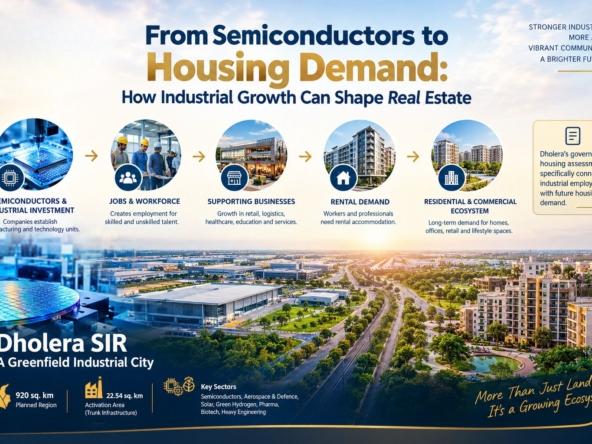
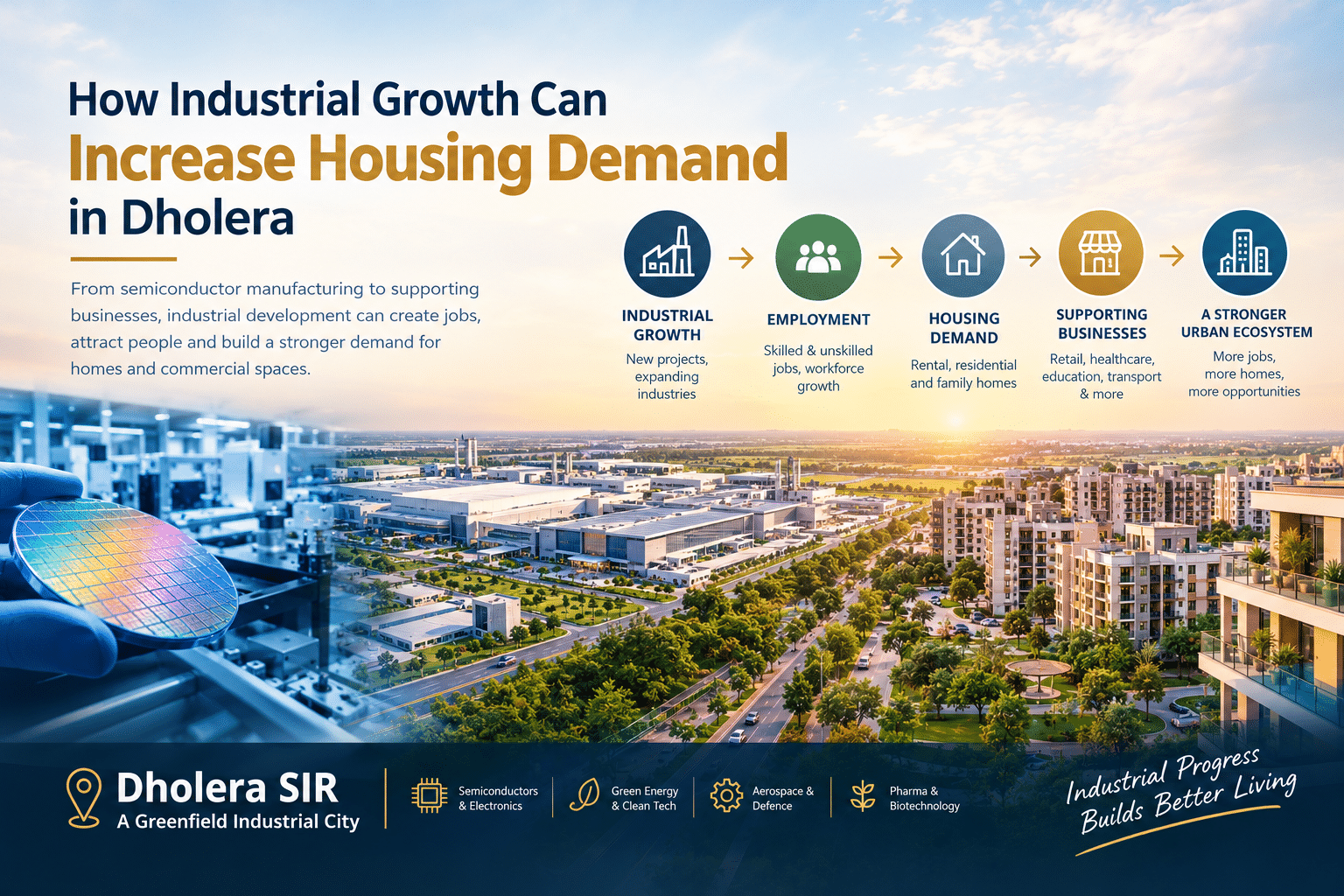
Industrial investment → Employment → Workforce → Housing requirement
The scale and timing of this demand, however, depend on the actual implementation and operationalisation of industrial projects.
2. Why the Semiconductor Ecosystem Matters
Semiconductors are one of the key focus sectors identified for Dholera.
According to NICDC, Dholera is being developed as India’s semiconductor city, with semiconductors listed among its major focus sectors.
The semiconductor industry can also support a wider ecosystem beyond the main manufacturing facility.
It can involve:
- Component suppliers
- Equipment manufacturers
- Engineering companies
- Logistics providers
- Maintenance and technical services
- Research and technology businesses
- Ancillary manufacturing units
- Professional services
This means that the impact of industrial development should not be viewed only through the number of employees working inside one facility.
A larger industrial ecosystem can potentially bring together companies, employees, suppliers and service providers, creating broader economic activity.
3. More Jobs Can Mean More People Moving to the Region
Employment opportunities can influence migration.
When companies begin operating in a developing industrial location, some employees may relocate from other cities or regions.
Different workers may have different housing requirements.
For example:
Industrial workers may require affordable accommodation close to employment centres.
Young professionals may prefer rental apartments.
Managers and senior professionals may seek higher-quality residential options.
Families may look for larger homes with access to schools, healthcare, retail and other social infrastructure.
Therefore, employment growth does not necessarily create demand for only one type of property.
It can contribute to a multi-layered housing ecosystem.
4. Rental Housing Can Become an Important First Step
People relocating for employment do not always purchase a property immediately.
Many employees initially choose rental accommodation while they understand their workplace, commute, neighbourhood and long-term plans.
This makes rental housing an important part of an emerging industrial city.
The Government of India’s Dholera rental-housing assessment specifically examined residential demand arising from industrial employment and infrastructure development. It identified employees of current and upcoming industries as an important source of rental-housing demand.
This suggests an important sequence:
New industries → New employees → Relocation → Rental demand → Residential ecosystem
Over time, if employment and population growth become sustained, the housing market can become more diversified.
5. Supporting Businesses Can Increase Housing Demand
Industrial employees require more than a place to work.
They also need everyday services.
As an industrial ecosystem develops, supporting businesses may include:
- Restaurants and cafés
- Grocery and retail stores
- Healthcare services
- Schools and education
- Transportation services
- Hotels
- Banks and financial services
- Professional services
- Maintenance and facility services
- Warehousing and logistics
These businesses create their own workforce.
That means industrial development can have a second-level employment effect.
For example:
Manufacturing company → Employees
Then:
Employees → Demand for restaurants, retail, transport, healthcare and other services
And those businesses also require:
Employees → Additional housing demand
This is one reason why the economic impact of an industrial cluster can extend beyond its physical boundaries.
6. The Economic Multiplier Effect
This broader relationship is often described as an economic multiplier effect.
A major industrial investment can create direct employment within the company while also generating indirect and supporting economic activity.
For Dholera, this becomes particularly relevant because the development model is not based on one isolated industry.
NICDC identifies multiple focus sectors, including semiconductors, aerospace and defence, solar component manufacturing, green hydrogen, pharmaceuticals and biotechnology, and heavy engineering.
A diversified industrial base can potentially create demand across several categories of workers and businesses.
The resulting ecosystem can be visualised as:
Industrial Investment
↓
Manufacturing & Business Activity
↓
Direct Employment
↓
Workforce Migration
↓
Rental Housing Demand
↓
Residential Development
↓
Retail & Commercial Activity
↓
Wider Urban Ecosystem
This is a development pathway—not a guarantee of property appreciation.
7. Infrastructure Is Critical to Housing Demand
Industrial growth alone is not enough.
People also want to live in locations where they can access reliable infrastructure and essential services.
That includes:
- Roads
- Public transportation
- Power
- Water
- Digital connectivity
- Healthcare
- Education
- Retail
- Recreational facilities
Dholera’s development framework includes trunk infrastructure in the Activation Area, while external connectivity is being developed through major road, rail and airport infrastructure. NICDC also describes Dholera as a planned smart and sustainable community.
For the residential market, this is important because employees typically consider both where they work and where they can comfortably live.
8. From Worker Housing to Family Housing
Housing demand can evolve as a city matures.
In the initial stages of industrial development, demand may be concentrated around:
- Worker accommodation
- Rental units
- Temporary housing
- Hostels and shared accommodation
As employment becomes more established, the housing requirement can become broader:
- Apartments
- Family homes
- Larger residential units
- Schools and childcare
- Healthcare facilities
- Retail and lifestyle spaces
This transition can gradually contribute to the development of a more complete residential ecosystem.
However, the timing of such a transition depends on actual industrial occupancy, employment growth, population movement and supporting infrastructure.
9. Commercial Real Estate Can Grow Alongside Housing
Housing is only one part of an emerging city.
As more people live and work in a region, businesses need locations to serve them.
This can create demand for:
Retail
Supermarkets, stores, restaurants and everyday services.
Offices
Professional services, consultants, financial services and other businesses.
Hospitality
Hotels and accommodation for business visitors and professionals.
Logistics
Warehousing, distribution and transportation services.
Service Businesses
Healthcare, education, maintenance and other local services.
Therefore, industrial development can influence both residential and commercial real estate.
10. Why Dholera’s Development Model Is Important
Dholera is being developed under the broader National Industrial Corridor Development Programme.
NICDC describes the programme as an initiative aimed at developing futuristic industrial cities that can support manufacturing, investment, employment and economic growth.
Dholera is therefore being planned as more than an industrial land parcel.
The larger objective involves creating an integrated environment where industrial activity, infrastructure and urban development can function together.
This is particularly relevant when evaluating future housing demand.
11. What Should Property Buyers Watch?
Industrial development can create opportunities, but buyers should avoid assuming that every property near an industrial project will automatically benefit.
Before purchasing property in or around Dholera, it is important to evaluate several factors.
Industrial Progress
Are announced industrial projects moving toward actual construction and operations?
Employment
Is there evidence of real employment creation rather than only future projections?
Infrastructure
Are roads, utilities and other essential services available or progressing according to official plans?
Location
How accessible is the property from employment centres and major infrastructure?
Rental Demand
Is there genuine demand from employees, professionals and businesses?
Legal Documentation
Are title, land use, approvals, development permissions and ownership documents properly verified?
Development Timeline
How long could it take for the surrounding ecosystem to mature?
These questions can provide a much more practical basis for evaluating property than simply looking at future price expectations.
12. Is Industrial Growth Enough to Create Housing Demand?
Not necessarily.
Industrial development is an important driver, but housing demand depends on several interconnected factors.
A useful framework is:
Industrial Activity + Employment + Connectivity + Infrastructure + Population Growth = Potential Housing Demand
If industrial activity grows but workers do not relocate, housing demand may remain limited.
If employment grows but infrastructure and services are inadequate, residential development may take longer.
If infrastructure improves without sufficient economic activity, demand may also develop slowly.
This is why investors and buyers should look at the complete ecosystem rather than a single development announcement.
13. The Bigger Picture for Dholera
Dholera’s development represents a long-term industrial and urban-development story.
The government has already examined the relationship between industrial employment and housing requirements in Dholera, while current official planning continues to position the region as a major industrial destination.
The Ministry of Electronics and Information Technology has also reported an approved Electronics Manufacturing Cluster at Dholera’s Activation Area, with projected investment and employment commitments associated with the cluster.
These developments make the relationship between industrial growth and housing demand an important factor to monitor.
But the key is to distinguish between:
Planned development
and
Actual development
For anyone evaluating the residential market, the second is ultimately more important.
Conclusion
Industrial development can influence housing demand through a simple but powerful chain:
Companies create jobs.
Jobs attract people.
People need homes.
People create demand for services.
Services create more employment.
And gradually, an industrial zone can begin developing into a broader urban ecosystem.
Dholera’s focus on sectors such as semiconductors, aerospace and defence, renewable-energy-related manufacturing and other industries provides the foundation for this potential economic cycle.
However, housing demand should not be viewed as an automatic outcome or a guarantee of property returns.
For property buyers, the more meaningful approach is to monitor industrial progress, employment, infrastructure, population movement, rental demand and property documentation.
Because the real question is not simply:
“How much can property prices increase?”
It is:
“Is the economic ecosystem developing strongly enough to create sustainable demand for people to live, work and do business here?”
That is the question worth watching as Dholera continues to develop.
Frequently Asked Questions
1. How can industrial growth increase housing demand in Dholera?
Industrial growth can create employment, attract workers and professionals, and increase demand for rental and residential accommodation. Supporting businesses can create additional employment and housing requirements.
2. Why are semiconductors important for Dholera?
Semiconductors are one of Dholera’s identified focus sectors. A semiconductor ecosystem can also support suppliers, logistics, engineering, maintenance and other businesses, potentially broadening the employment base.
3. Will industrial development guarantee property appreciation?
No. Industrial development does not guarantee property appreciation. Property performance depends on location, infrastructure, legal status, supply and demand, market conditions and the actual pace of development.
4. Is rental housing relevant to Dholera?
Yes. A government assessment of Dholera’s rental-housing requirements identified employees of current and upcoming industries as an important source of potential rental demand.
5. What should buyers verify before purchasing property in Dholera?
Buyers should independently verify ownership/title, land use, approvals, development permissions, location, infrastructure, access and the credentials of the developer or seller before making a purchase.
6. What is the biggest factor to watch in Dholera’s housing market?
Rather than focusing on one factor, buyers should monitor the complete ecosystem: industrial activity, employment, infrastructure, connectivity, population movement, rental demand and supporting commercial development.