Introduction
When a new industrial ecosystem begins to take shape, its impact is rarely limited to factories and manufacturing facilities. Large-scale industrial development can gradually create employment, attract workers and professionals, increase demand for supporting services, and influence the need for housing and commercial spaces.
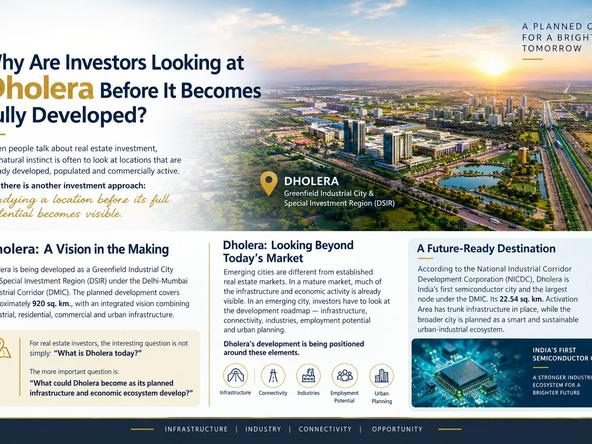
This relationship is particularly relevant in Dholera Special Investment Region (DSIR), Gujarat, which is being developed as a greenfield industrial city and a major node of the Delhi–Mumbai Industrial Corridor (DMIC).
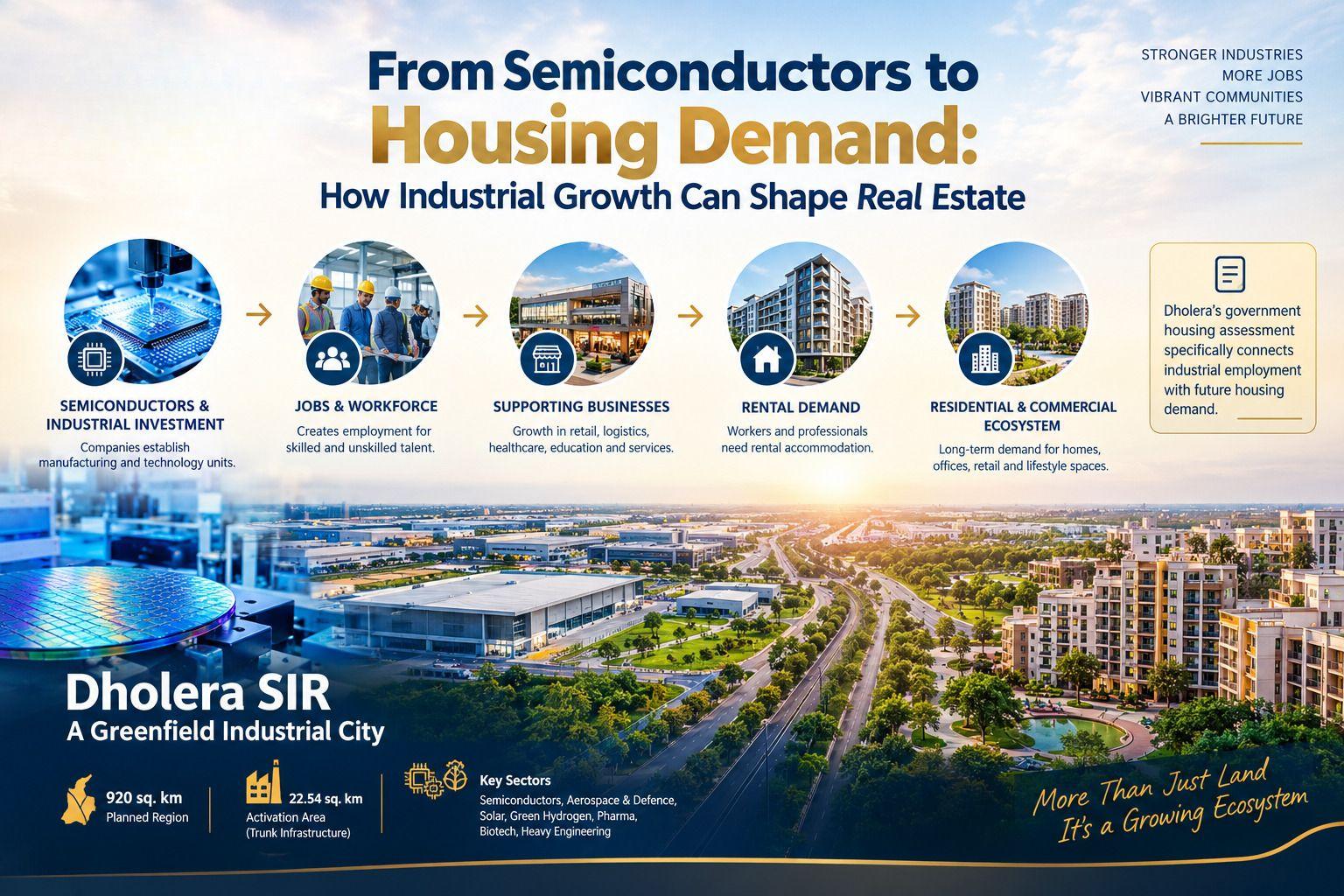
Dholera has been planned around sectors such as semiconductors, aerospace and defence, solar component manufacturing, green hydrogen, pharmaceuticals and biotechnology, and heavy engineering. According to NICDC, the 22.54 sq. km Activation Area has trunk infrastructure in place, within the larger 920 sq. km DSIR.
As industrial activity expands, an important question emerges:
Can industrial growth create a broader ecosystem that eventually influences residential and commercial real estate demand?
The answer requires understanding how cities develop around employment centres.
1. From Companies to Jobs: Where the Real Estate Connection Begins
Industrial investment typically starts with companies establishing manufacturing facilities, research centres, warehouses, infrastructure projects or supporting operations.
Once these facilities become operational, they require people.
These may include:
- Engineers and technical professionals
- Factory and production workers
- Managers and administrative employees
- Logistics and supply-chain workers
- Construction and infrastructure workers
- Security and facility-management staff
- Hospitality and service-sector employees
Dholera’s government housing assessment provides an important indication of this relationship. A Ministry of Housing and Urban Affairs document on rental housing in Dholera states that the region’s industrial sectors are expected to generate significant employment and that housing demand is directly connected to industrial workers and people involved in infrastructure development.
This creates a simple economic chain:
Industrial investment → Employment → Workforce → Housing requirement
The scale and timing of this process, however, depend on actual industrial implementation and population growth.
2. The Semiconductor Ecosystem Can Extend Beyond the Factory
Semiconductor manufacturing is not an isolated activity.
A semiconductor ecosystem can involve multiple layers of businesses, including component suppliers, equipment providers, logistics companies, maintenance services, engineering firms, technology companies and other supporting industries.
NICDC currently identifies semiconductors as one of Dholera’s focus sectors, alongside aerospace and defence, solar component manufacturing, green hydrogen, pharmaceuticals and biotechnology, and heavy engineering.
As these industries develop, the surrounding economy can become more diverse.
For real estate, this distinction matters.
The demand created by a single factory may be different from the demand created by an expanding industrial ecosystem containing multiple companies and supporting businesses.
3. Supporting Businesses Can Create Additional Demand
A growing industrial area requires more than manufacturing facilities.
Employees and businesses also need everyday services.
Over time, industrial development can create demand for:
- Restaurants and cafés
- Retail stores
- Medical facilities
- Schools and educational services
- Transportation services
- Hotels and hospitality
- Warehousing and logistics
- Professional services
- Office spaces
- Maintenance and facility services
This is where the concept of an economic multiplier effect becomes relevant.
One major industrial project can support activity across several other sectors. As the business ecosystem expands, the requirement for commercial and residential infrastructure can also evolve.
However, the extent of this effect depends on actual employment, industrial occupancy, infrastructure availability and population growth.
4. Why Rental Housing Can Become Important
Not every person moving into an emerging industrial city will immediately purchase a home.
Workers, professionals, contractors and employees relocating for employment may initially prefer rental accommodation.
This makes rental housing an important part of an industrial city’s development.
A government assessment specifically prepared for Dholera examined rental housing requirements and noted that housing demand could arise from industrial workers as well as workers connected with infrastructure development.
More recently, NICDC’s 2026 consultancy tender for worker-housing demand assessment includes Dholera among the industrial cities being studied. The scope includes assessing current and projected workforce, industrial clusters, anchor tenants, supply-chain components and residential demand by income level, migration pattern and housing preference.
This shows why housing should be viewed as part of the broader industrial-city ecosystem rather than as a completely separate sector.
5. Industrial Growth Can Influence Different Types of Housing Demand
Housing demand around an industrial city is not necessarily uniform.
Different groups may have different requirements.
Workforce Housing
Industrial and construction workers may require affordable rental accommodation close to employment zones.
Rental Apartments
Young professionals, engineers and employees relocating from other cities may prefer apartments or managed rental accommodation.
Family Housing
As employees settle for longer periods, demand may gradually expand toward larger homes suitable for families.
Residential Plots
Some buyers may look for land or residential plots based on their long-term plans, although any such purchase should be evaluated independently based on title, land use, approvals, location and infrastructure.
The important point is that employment growth can create multiple layers of housing requirements rather than one single category of demand.
6. Commercial Real Estate Is Part of the Same Ecosystem
Residential development is only one side of the equation.
A growing workforce also requires places to work, shop, eat, meet and access services.
This can create opportunities for:
- Retail
- Offices
- Business centres
- Hospitality
- Warehousing
- Logistics facilities
- Service businesses
Therefore, the development of an industrial city can gradually create a broader residential + commercial ecosystem.
Dholera’s planned development model is intended to integrate industrial activity with urban infrastructure. NICDC describes DSIR as a planned smart and sustainable community, with infrastructure and utilities designed to support industrial development.
7. Infrastructure Is the Link Between Industry and Real Estate
Industrial activity alone does not automatically create a successful real estate market.
Connectivity and urban infrastructure are equally important.
People and businesses need:
- Roads
- Public transportation
- Reliable power
- Water supply
- Digital connectivity
- Healthcare
- Education
- Retail and social infrastructure
Dholera’s development includes trunk infrastructure within the Activation Area, while its wider connectivity framework links the region to major transportation networks.
For real estate buyers, this means that simply hearing about a large industrial project should not be enough.
A more useful approach is to ask:
Where is the actual infrastructure? How accessible is the property? What development has already taken place? What is officially planned?
8. What This Could Mean for Dholera’s Real Estate Ecosystem
If industrial development continues to translate into operational businesses and employment, the potential chain could look like this:
Industrial Investment
↓
Manufacturing & Business Activity
↓
Employment Generation
↓
Workforce Migration / Population Growth
↓
Rental Housing Demand
↓
Residential Development
↓
Retail & Commercial Services
↓
A More Complete Urban Ecosystem
This is not a guarantee of property appreciation. Instead, it is a framework for understanding how economic activity can influence real estate demand over time.
9. What Should Property Buyers Watch?
Anyone evaluating real estate around Dholera should look beyond headlines and advertised prices.
Some important indicators include:
1. Industrial Progress
Are announced projects moving toward actual construction and operations?
2. Employment
Is industrial activity creating measurable employment?
3. Infrastructure
Are roads, utilities and other essential services operational or progressing according to official plans?
4. Population Movement
Are workers and professionals actually moving into the region?
5. Rental Demand
Is there evidence of genuine demand from employees and businesses?
6. Commercial Activity
Are retail, hospitality, offices and other supporting services emerging?
7. Property Documentation
Are ownership, approvals, land use and development permissions properly verified?
These indicators can provide a more meaningful picture than relying solely on future projections.
10. The Bigger Picture: Real Estate Follows Economic Activity
The development of a city is rarely driven by real estate alone.
Historically, employment centres, transportation infrastructure and business activity have played an important role in shaping urban growth.
Dholera’s development model places industrial activity at the centre of a planned urban ecosystem. The government has also examined worker and rental housing requirements as part of the region’s development needs.
This makes the relationship between industrial growth and housing demand an important topic for anyone studying Dholera’s long-term development.
The key question is therefore not simply:
“Will property prices increase?”
A more useful question is:
“Is economic activity developing strongly enough to create sustained demand for homes, rentals, services and commercial spaces?”
That is the indicator worth watching.
Conclusion
Dholera’s story is bigger than semiconductor manufacturing or individual real estate projects.
If industrial projects become operational, employment expands and supporting businesses develop, the region could gradually require a wider ecosystem of housing, rental accommodation, retail, hospitality and commercial services.
The government’s own housing assessment has already recognised the connection between industrial employment and housing requirements in Dholera.
For prospective property buyers, however, the right approach is to separate development potential from speculation.
Track actual infrastructure. Follow industrial progress. Verify property documentation. Understand the location. Study demand.
Because ultimately, sustainable real estate demand is generally connected not just to what a city is planned to become, but to the economic activity and people that actually begin to make it a city.
Frequently Asked Questions
Q1. How can semiconductor manufacturing affect housing demand in Dholera?
Semiconductor manufacturing can create direct employment as well as demand for supporting industries and services. As the workforce grows, the need for rental and residential accommodation can also increase.
Q2. Is housing demand in Dholera officially being studied?
Yes. Government documents have assessed rental housing requirements in Dholera, and a 2026 NICDC consultancy tender includes Dholera in a broader assessment of worker-housing and residential demand across industrial cities.
Q3. Does industrial development guarantee property appreciation?
No. Industrial development does not guarantee real estate returns. Property performance depends on several factors, including location, legal status, infrastructure, demand, supply, market conditions and the pace of actual development.
Q4. What should investors verify before purchasing property in Dholera?
Buyers should independently verify title, land use, approvals, development permissions, access roads, infrastructure availability and the credentials of the developer or seller before making a purchase.
Q5. Why is rental housing important in an industrial city?
Workers and professionals relocating for employment may initially prefer renting rather than purchasing. This can make rental housing an important component of an emerging industrial ecosystem.