Property Rates Up 80% Already. Will Jewar’s First Flight Lift Them F
Jewar Airport Impact: Office and business spaces in the region are being launched in the Rs 8,000-15,000 per square foot range.
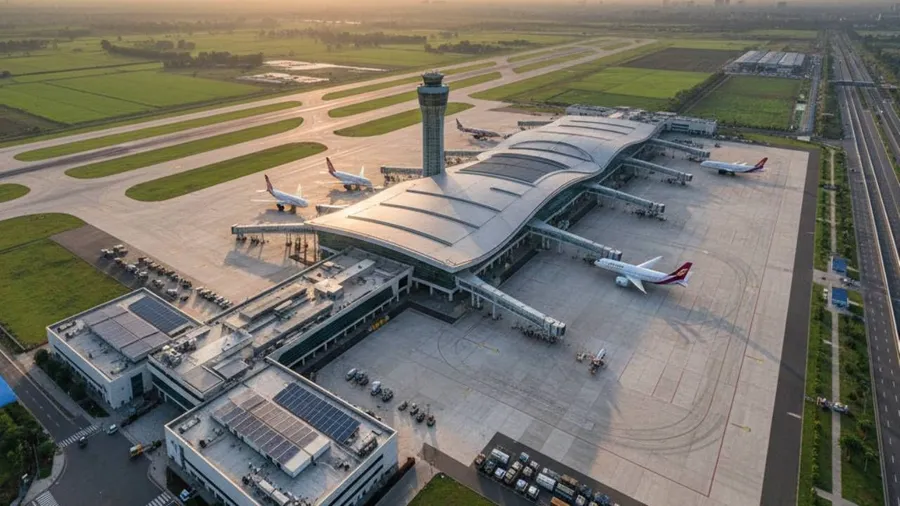
The first commercial flight took off from the Noida International Airport in Jewar on Sunday. This marked a milestone not just for aviation, but also for the wider Delhi-NCR real estate market.
For years, the airport has been viewed as a catalyst for growth along the Yamuna Expressway. Now, with operations beginning, developers, investors and homebuyers are watching closely to see whether the region can replicate the success stories of other airport-led economic hubs in the country.
Industry executives believe the airport’s impact will extend far beyond passenger traffic. The larger story, they say, is about jobs, businesses, logistics parks, commercial hubs and housing demand that could emerge around the new aviation gateway.
More Than Just An Airport
Rohit Kishore, CEO of Hero Realty, believes Jewar should be viewed through the lens of an “aerotropolis” — an urban ecosystem built around a major airport.
“Jewar represents a generational infrastructure opportunity, best understood through the aerotropolis lens,” Kishore said.
According to him, the region’s biggest advantage lies in the availability of large, contiguous land parcels that can support integrated industrial, commercial and residential development on a scale that is difficult to achieve elsewhere in NCR.
Kishore argues that while Delhi’s Aerocity has established itself as a successful commercial district, Jewar has the potential to evolve into a far larger self-sustaining urban ecosystem. He added that growing interest from developers reflects confidence in the long-term prospects of the corridor.
Hero Realty has already increased its presence in the region. The company recently acquired over 18,000 square metres of land in Greater Noida’s Sector MU through a GNIDA auction and plans to expand further in what it sees as a strategic growth belt.
Property Prices Have Already Started Rising
The airport’s influence is already visible in local property markets.
Ashish Bhutani, CEO of Bhutani Infra, said several micro-markets around the airport have witnessed price appreciation of 40-80 per cent over the past few years, even before commercial operations began.
“The next phase of growth is likely to be driven by actual business activity, job creation and infrastructure development,” Bhutani said.
Residential property prices along the corridor currently range between Rs 8,000 and Rs 12,000 per square foot, according to Bhutani. He expects further upside as demand expands across housing, offices, retail, hospitality and logistics segments.
The logic is straightforward. Airports attract businesses. Businesses create jobs. Jobs create demand for homes, offices, hotels, warehouses and retail spaces.
This multiplier effect has played out around major airports globally. Real estate players believe Jewar could follow a similar trajectory over the coming decade.
Housing Demand Could Get A Fresh Boost
Improved connectivity has historically been one of the strongest drivers of residential demand.
The airport is expected to make the Yamuna Expressway and Greater Noida corridors more attractive to both end-users and investors. Better road, rail and metro connectivity planned around the airport is likely to strengthen this trend.
Industry estimates suggest apartment prices in airport-led growth corridors could rise by nearly 22 per cent over the next two years, while plotted developments could see appreciation of around 28 per cent.
For buyers, the appeal goes beyond property appreciation. As businesses move into the region, the possibility of living closer to workplaces could make these emerging neighbourhoods more attractive.
Offices And Commercial Real Estate Stand To Gain
The impact may be equally significant for commercial real estate.
Experts expect stronger demand from technology companies, multinational corporations, logistics operators and aviation-linked businesses looking to establish a presence near the airport.
Commercial pricing already reflects growing confidence. Office and business spaces in the region are being launched in the Rs 8,000-15,000 per square foot range, while premium retail assets command even higher rates.
The Mahamaya-Advant corridor in Noida is also expected to benefit from the airport’s opening despite being located away from the immediate airport zone. Real estate experts believe improved connectivity, a mature commercial ecosystem and established social infrastructure could make the stretch a preferred destination for businesses looking to expand in NCR.
Ripple Effects Beyond Noida
The benefits may not stop at Noida and Greater Noida.
Manik Malik, CEO and President of BPTP, said Faridabad could also emerge as a beneficiary because of a series of connectivity projects that are either under development or planned.
These include the FNG Expressway, Greenfield Expressway, Delhi-Mumbai Industrial Corridor (DMIC) and the proposed Namo Bharat corridor.
According to Malik, these projects could improve access between Faridabad and the airport while strengthening links between residential areas and employment hubs. The resulting economic activity could support both housing and commercial development in the city.
‘Planning Is The Next Big Challenge’
The airport’s first flight is symbolic. The real test begins now. Much will depend on how quickly supporting infrastructure, industrial zones, logistics parks and commercial districts take shape around the airport.
Developers argue that India already has the demand fundamentals required to create a successful airport-led economic ecosystem. The next challenge will be ensuring coordinated planning, faster land development and smoother execution of infrastructure projects.
Gaurav K Singh, Founder and Chairman of Womeki Group, believes the airport’s location within NCR and its connectivity to major expressways and industrial corridors gives it the ingredients needed to become a major economic hub.
“An aerotropolis around Jewar’s Noida International Airport is promising, given its location within NCR and access to key expressways and industrial corridors. It can evolve into a hub for logistics, warehousing and aviation-linked businesses,” Singh said.
However, he cautioned that execution remains the biggest hurdle.
“India’s land fragmentation, regulatory delays and lack of synchronised infrastructure planning can slow such large-scale developments. Unlike Dubai or South Korea, where centralised planning enabled faster rollouts, India’s model will take longer to mature,” he added.
Singh pointed to a recent Square Yards research report, which estimates that plot values along the Yamuna Expressway corridor could rise by 28 per cent and apartment prices by 22 per cent by 2027, underscoring the long-term confidence investors continue to place in the region.