
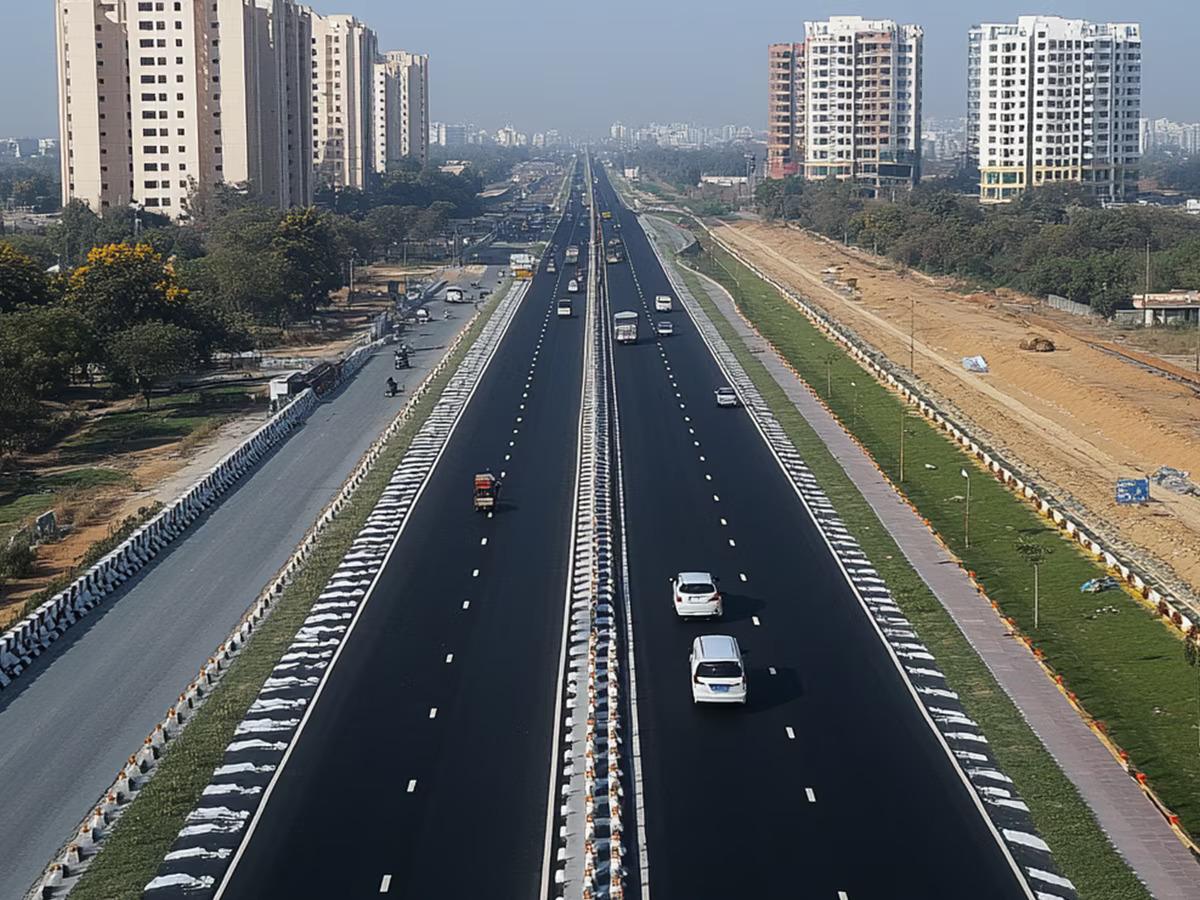
To cope with the potential surge in traffic following the opening of the Noida International Airport, the Noida Authority has proposed a 10-lane Pushtha Road running along the Yamuna embankment. This initiative aims to enable vehicles arriving from Delhi to bypass the Noida Expressway and proceed directly toward the Yamuna Expressway and Jewar.
To address the anticipated increase in traffic volume, the Noida administration recently formulated a plan to construct a new 10-lane road leading up to the Jewar Airport. According to the proposal, the existing Pushtha Road will be upgraded into a 10-lane corridor. This section will connect with the Chilla Elevated Road, which is currently under construction.
This constitutes a proactive measure taken to streamline traffic movement on the Noida-Greater Noida Expressway. A substantial increase in traffic volume is anticipated once the Jewar International Airport becomes fully operational.
These projects are expected to create an alternative route connecting Delhi to the Jewar Airport. This route will bypass the existing expressway.
How the New Corridor Will Function: This project comprises three key components:
The Chilla Elevated Road
A New Link Road from the Mahamaya Flyover
The Widened Pushta Road
The Chilla Elevated Road
The estimated cost exceeds ₹893 crore.
Its total length is 5.9 kilometers.
It connects the Chilla Regulator in Delhi to the Mahamaya Flyover in Noida.
Approximately half of the work has been completed, and the project is expected to be ready by December 2027.
A 1.4 km Elevated Link from Mahamaya to Pushta Road
The Noida Authority has proposed a route extending from the Mahamaya Flyover towards the Okhla Bird Sanctuary Metro Station.
Once constructed, this link will channel vehicles arriving from Delhi directly onto Pushta Road, bypassing the Noida Expressway entirely.
Widening of Pushta Road Along the Banks of the Yamuna River
Currently, this is a 31.2-kilometer-long, four-lane route running from Sector 94 along the Yamuna embankment up to the Yamuna Expressway near Gharbara village. The plan involves initially widening it to six lanes, with a provision for future expansion up to 10 lanes. This route will terminate near the Yamuna Expressway, opposite Gautam Buddha University.
Why Does Noida Need an Alternative to the Expressway?
According to Krishna Karunesh, CEO of the Noida Authority, the existing expressway serves as the primary arterial road connecting Noida, Greater Noida, and Jewar. Once the airport becomes operational, there is expected to be a massive surge in traffic volume.
Reasons for Constructing Another Corridor:
To avoid future traffic bottlenecks on the Noida-Greater Noida Expressway.
To provide a bypass route for long-distance traffic that does not enter the city’s core areas.
To support new developments near Gautam Buddha University and along the Yamuna Expressway.
Pushta Road currently features two lanes on each side. One side of the road abuts flood-prone land, which could potentially be utilized to widen the road. However, this would require obtaining the necessary approvals. According to officials, a formal proposal is being drafted and will be submitted for approval.
Parallel Plan for an Elevated Corridor on the Same Alignment
Alongside the proposal to widen Pushta Road, a separate proposal already exists for a 31.2-kilometer-long, six-lane elevated road running along the same alignment—the Yamuna embankment—from the Okhla Barrage (near Sector 94) to the Yamuna Expressway.
Key Features of This Elevated Corridor Plan:
Length: 31.2 km; six lanes.
Route Alignment: Follows the general route of Pushta Road along the banks of the Yamuna River.
It includes three loops designed to connect with Noida’s central sectors.
A feasibility study is currently underway, led by Almondz Global Infra, a consultancy firm appointed by UPEIDA.
Last month, teams from UPEIDA and the Irrigation Department inspected the proposed route. Once the consultant submits their findings, a Detailed Project Report (DPR) is expected to be received within three months. If approved, the construction work could be completed within 24 months.